

Cost · 2 min
Using reserved capacity well: when RCS3 and RCS5 pay off
Pay-as-you-go is flexible; a commitment rewards predictable volume with up to 46 percent off. When the switch pays.
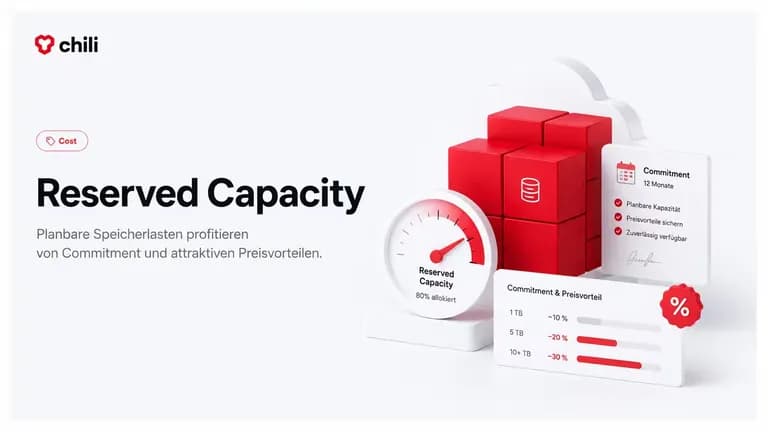
Book object storage and you pick one of two pricing logics. Pay-as-you-go bills per terabyte occupied and ties you to nothing. Reserved capacity flips that around: you commit a volume for a fixed term and get a lower price in return. The question worth asking is rarely which logic wins. It is which part of your data belongs to which.
Four models, one slope
chili splits this into four models. PAYG runs without commitment. RCS1 binds for a year, RCS3 for three, RCS5 for five. Two levers push the per-terabyte price down: the length of the commitment and the size of the volume. On PAYG below 10 terabytes you pay CHF 16.00. At the other end, on RCS5 from 1'000 terabytes, CHF 6.90. That is roughly 46 percent below what PAYG costs on the same volume tier (CHF 13.00).
What belongs on a long commitment
The call follows a single line. Anything you occupy reliably and for the long run belongs on reserved capacity. Anything that fluctuates, or whose size you cannot yet judge, stays on PAYG. A business with a stable data base and reasonably predictable growth runs noticeably cheaper on RCS3 or RCS5. One that cannot yet estimate its volume starts on PAYG and switches the moment a baseline becomes visible.
Split the baseline from the peak
In reality it is seldom all predictable and seldom all open. So splitting pays: the reliable baseline moves to reserved capacity, the peaks and the uncertain growth run on PAYG. You lock in the low price for the biggest chunk and stay nimble on the rest, without overreaching.
Why the list price is also the final price
The term discount is only half the bill. With chili nothing lands on top: no egress, no API fee, no retrieval cost. The per-terabyte price on the rate sheet is the price you pay at the end of the month. Nobody adds a line item for reaching your own data. This second half is what makes the bill genuinely predictable, because a discount helps little if variable extras eat it back up. To see how the models behave for your actual volume, the storage cost calculator works it out: it tells you from what point which model pays.