

Compliance · 3 min
Object Lock explained: tamper-proof retention for FINMA and revDSG
How WORM storage works and why it is becoming the default for regulated Swiss data.
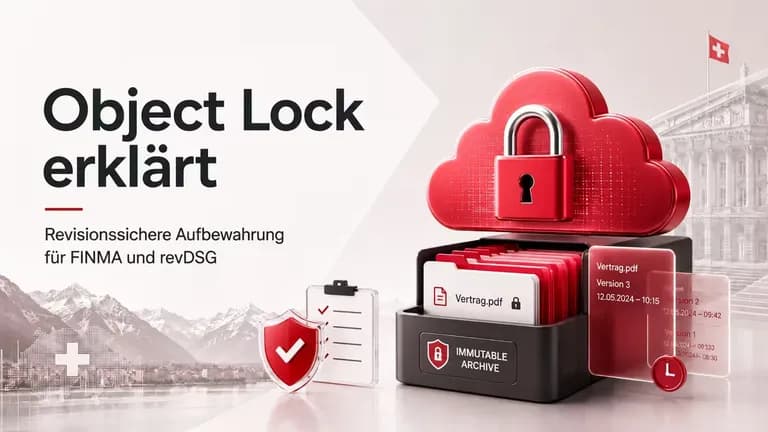
A backup you can delete is no backup when it counts. When ransomware hits, the production data is rarely the only casualty anymore. Attackers go for the backups first, because that is where the real pressure point sits: with the copies gone, paying the ransom is often the only option left. Object Lock breaks that logic by making data immutable for a set period.
Write once, read many, no exceptions
Object Lock brings the WORM principle to object storage. An object is written once and then cannot be overwritten or deleted for the defined retention period. The lock sits at the level of the individual object version, directly in storage rather than in some upstream application that could be bypassed.
What sets it apart from an ordinary backup is enforcement. No administrator, no stolen access key and no attacker with full privileges removes a locked object before the period runs out. Immutability here is not a policy you can reconfigure. It is a property of the storage layer.
Two modes, plus a lock with no expiry
There are two retention modes to choose from. In governance mode an object is protected, but roles with special permission may lift the lock in a controlled way. That fits internal rules where a correction should stay possible if something goes wrong.
Compliance mode leaves no such back door. Before the period expires, no one lifts the lock, not even the account owner. This is the mode for regulatory retention, where immutability has to be provably guaranteed.
On top of that sits legal hold, a lock with no fixed expiry. It stays in place until it is explicitly released, for example for the duration of ongoing legal proceedings, and it combines with either mode.
What Swiss regulation demands
Retention obligations in Switzerland go beyond simply owning a copy. The ordinance on the keeping of business records requires tamper-proof retention of many documents over ten years, meaning immutable and traceable. FINMA-regulated institutions carry additional record-keeping duties, and the revised Data Protection Act tightens the requirements for integrity and traceability.
Object Lock in compliance mode delivers tamper-proof retention at a technical level. Rather than promising organisationally that no one touches the data, the storage itself makes that impossible. In front of an auditor, that evidence carries more weight than any process description.
More than a checkbox for auditors
The benefit does not stop at the audit. Immutable copies are the most effective answer to the two most common causes of data loss, ransomware and human error. An encrypted or accidentally deleted production dataset can be pulled back from a locked copy, because the attack never reached it.
A test for your own retention
At chili, Object Lock is available natively over the S3 API, in compliance and governance mode as well as legal hold. According to their vendors, Veeam and rclone apply the locks on S3-compatible providers such as chili. For compliance mode, contact chili beforehand: you agree retention and duration in a retention agreement. Storage is in an ISO 27001-certified datacenter in Zurich, optionally geo-redundant across Zurich and Geneva, and the data does not leave Switzerland. If you want to know whether your own retention holds up, ask IT one simple question: can our most recent backup be deleted with admin rights? If the answer is yes, a bucket with Object Lock switched on is the next step.