

Cost · 3 min
TCO comparison: Swiss object storage providers in plain terms
The list price is one number, the total cost is another. Three factors decide for Swiss object storage: price, egress and WORM.
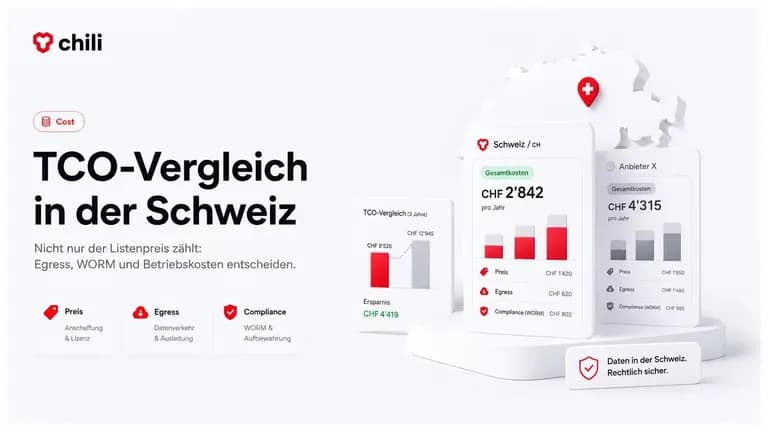
The price per terabyte sits at the top of every quote. It is also the number that says the least about what actually gets charged at the end of the month. Total cost rests on three items: the storage price itself, the fees for reaching your own data, and whether immutable storage is included at all.
Why a low base price proves little
On top of the storage price come egress and retrieval fees, the effort for geo-redundancy, and the value of whatever ships without a surcharge. If a central function like immutable storage is missing, you buy it somewhere else or rebuild it. That belongs in the calculation even though it appears on no price list. A low entry price without WORM can end up costlier than a higher price that includes it.
The Swiss providers, as of 7 October 2026
The figures below come from public price lists and documentation. Infomaniak lists object storage in its Public Cloud at around CHF 10.95 per terabyte; its immutable storage is limited to the Acronis-native backup format and not documented for S3 access. cloudscale.ch sits at around CHF 30.00 per terabyte plus egress and currently offers Object Lock at one location (RMA). Exoscale SOS brings Object Lock including legal hold, bills storage by the hour per GiB (price band 1 around CHF 18.70 per terabyte) and charges egress on a usage basis. chili costs CHF 16.00 to CHF 13.00 per terabyte on pay-as-you-go and from CHF 6.90 with Reserved Capacity (RCS5, 5 years, from 1'000 TB), offers native Object Lock in compliance mode as an add-on and has no egress fees; retrieving your stored data volume once per month is included (fair-use limit).
Egress hits when you need the data
Egress is often billed in tiers and lands precisely when you actually retrieve your data, on a restore for instance. As long as nothing happens, the bill looks harmless. The emergency flips it. Compare storage costs only at rest and you leave out the one situation the backup exists for.
Not every Object Lock is the same
Object Lock appears on plenty of datasheets without meaning the same thing everywhere. Two things decide it. First, whether it is available S3-natively at bucket level and not only inside a proprietary backup format. Second, whether compliance mode is supported, where a lock stays until its retention expires and no one lifts it, not even the account owner. If WORM lives only in a single vendor's backup format or is absent, regulated data needs an extra product or a workaround. Both cost money and complexity, and neither surfaces in a pure price comparison.
What this means for regulated data
For retention driven by FINMA or the revFADP, S3-native Object Lock in compliance mode is a requirement, not a nice-to-have. This is where the shortlist shrinks below what the price list suggests: some options offer WORM only in governance mode, some only in a proprietary format, some do not document it publicly at all. chili pairs the low entry point with Object Lock in compliance mode and no egress, which often puts it ahead on TCO even though the list price is not the lowest.
Before you commit to a single number, run your own scenario. The storage cost calculator takes your real volumes and shows what is left at the end of the month once egress and WORM are priced in.