

Basics · 3 min
S3-compatible explained: what the S3 API means for your storage
Why a standard protocol keeps you independent of the provider, and what to watch for in compatibility.
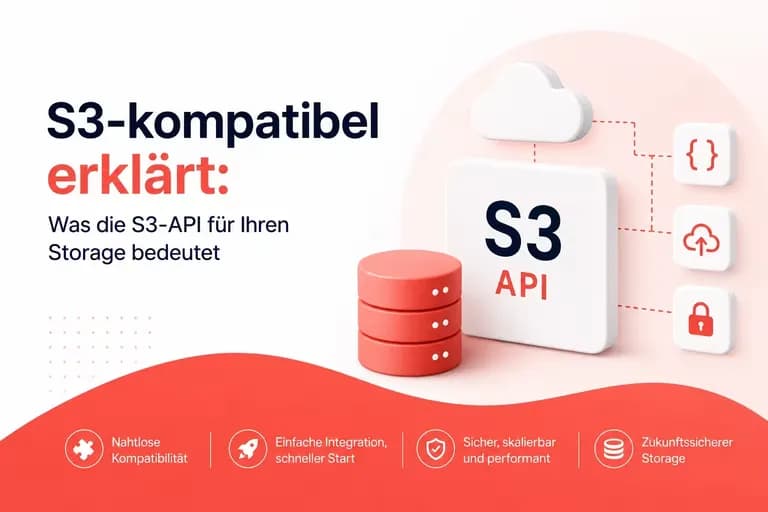
Barely a storage datasheet ships today without the label S3-compatible. It reads like a fixed standard, yet in practice it covers wildly different things. Two providers can both wave the S3-compatible flag and still be worlds apart. Knowing what the S3 API actually does, and where the label stops meaning anything, is what lets you buy the storage that fits your own tooling.
A protocol, not a filesystem
S3 is neither a disk nor a network share but an interface over HTTP. Data lands as objects in buckets and is addressed through a unique key. The core is narrow: write, read, list, delete. Amazon introduced the interface, and by now practically every storage platform and backup tool speaks it. That is how a proprietary API turned into the de-facto standard for object storage.
The payoff: interchangeable providers
The practical value fits into one sentence: same tools, different endpoint. rclone, the AWS CLI, boto3 and Veeam all talk the same protocol. Switching provider means, at best, swapping the endpoint and the access keys instead of rebuilding half your architecture. That is the opposite of vendor lock-in: the integration stays, the provider becomes a variable.
The fine print behind the label
S3-compatible is not a yes-or-no claim but a question of coverage. One provider implements multipart uploads for large files, versioning, lifecycle rules, presigned URLs and Object Lock; the next covers only the four basic operations. Both are allowed to call themselves compatible. So the only reliable move is to ask about the one feature your setup depends on, rather than trusting the word on the datasheet.
The questions to ask first
A short checklist separates the serious offers from the half-finished ones. Is Object Lock supported natively, for when you need immutable backups? Are versioning and lifecycle rules there for ongoing data housekeeping? Do multipart uploads hold up for large objects? Can access keys be granted at a fine grain? Every answered question means less friction when the storage plugs into tools you already run.
With chili the S3 interface is complete, including Object Lock, versioning and lifecycle rules. In concrete terms: point the endpoint at chili, enter the access keys, done. The rest of your tooling chain stays as it is. The data sits in Zurich, optionally geo-redundant across Zurich and Geneva, egress-free and from CHF 6.90 per terabyte per month (RCS5, 5 years, from 1'000 TB; pay-as-you-go from CHF 16.00).
The most honest test is still the hands-on one. Create a test bucket, wire it into your existing backup tool or into rclone, and check exactly the features you would rely on in a real incident before any production data changes provider.