

Compliance · 3 min
Commissioned data processing in the cloud: your duties under the revFADP and FDPIC
Outsourcing storage makes the provider a processor and leaves you responsible. What the law requires for that.
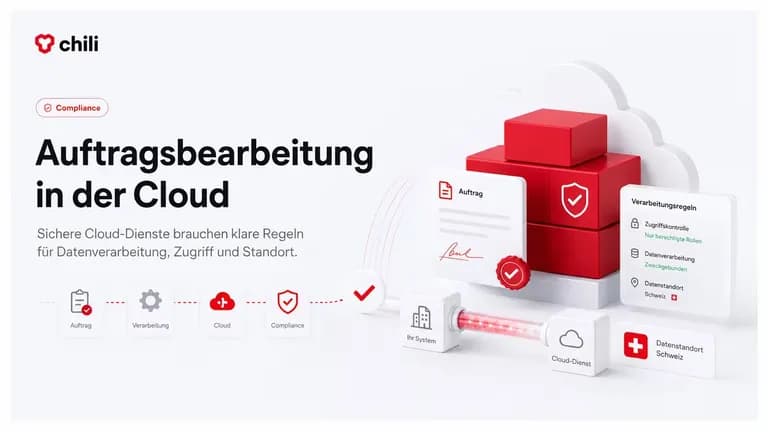
Moving personal data into a cloud hands off the storage, not the responsibility. From that point a third party processes the data on your behalf, and the revised Data Protection Act calls exactly this arrangement commissioned processing. The duties attached to it are ones you want to understand when you choose a provider, not when the audit arrives.
You stay responsible, even when the data lives elsewhere
Towards the data subjects and the Federal Data Protection Commissioner, your company remains the controller, even though the bits sit in the provider's datacenter. The processor may handle the data only on your instructions and only for the agreed purpose. That binding belongs in a contract, signed before the first records are transferred.
The real test is the sub-processors
Purpose, scope, duration and the technical and organisational measures are all set out in the data processing agreement. The actual test sits one layer down. If your provider brings in further service providers of its own, for infrastructure or support, they count as sub-processors and have to be named and approved by you.
An opaque chain of subcontractors is not a detail. It is the first place an audit gets stuck.
Data security also means being able to report an incident
The law explicitly requires appropriate technical and organisational measures: encryption, access control and provable data integrity. If a data security breach occurs, you have to report it to the commissioner. A provider that guarantees integrity technically through immutable storage all but hands you that evidence.
A Swiss provider settles the hardest question in advance
If the data stays under Swiss law and never leaves the country, the most delicate part falls away: disclosure abroad and the possible access of foreign authorities. Instead of documenting an exception, you simply have the default case. That saves effort and carries more weight in an audit than any statement of intent.
chili is set up precisely this way. The package includes a data processing agreement, a transparent list of sub-processors, storage in an ISO 27001-certified datacenter in Zurich, optionally geo-redundant across Zurich and Geneva, encryption and, as an add-on, native Object Lock for integrity. Operations are subject exclusively to Swiss law, and CLOUD Act access is ruled out.
A concrete test for your next provider review: before the first upload, ask for two documents, the data processing agreement and the current list of sub-processors. If both arrive without a follow-up question, commissioned processing is a clean contractual relationship. If you have to go looking, you already know the first finding of your audit.